



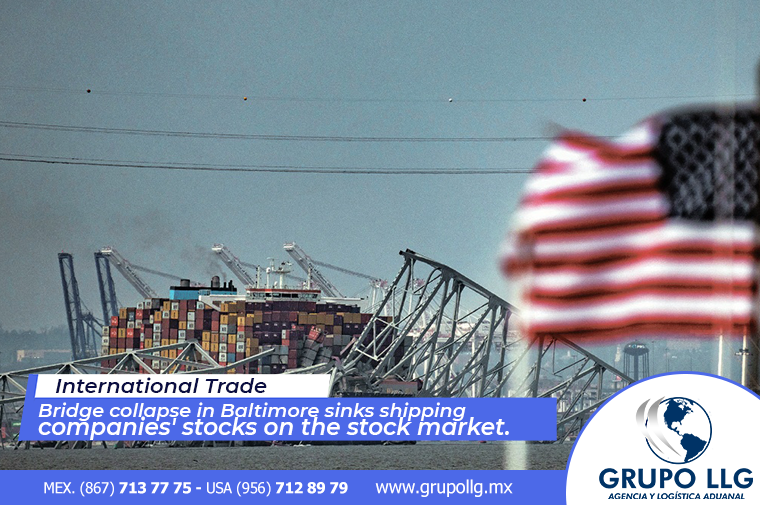
In terms of combined market value, companies in the industry that pass through the port of Baltimore lost nearly $2.289 billion on Tuesday.
The accident involving a ship that caused the collapse of a bridge in Baltimore in the early hours of Tuesday disrupted global supply chains and led to a drop in the shares of companies in the shipping and energy sectors.
Maersk, a Danish shipping company that chartered the ship that collided with the Francis Scott Key Bridge, saw its shares fall by up to 8% on the Copenhagen Stock Exchange following the collapse. By the end of the trading day, its shares had dropped by 2.64%, resulting in a market value loss of $542.83 million in a single day. Its market capitalization stands at $20.049 billion.
The ship, named Dalí, collided with the bridge around 1:30 a.m. Eastern Time on Tuesday, causing it to split in two and fall into the river. Although all crew members were located, the collision resulted in several vehicles sliding into the water.
The Mexican Consulate in Washington DC announced that there are six missing workers, including Mexicans, Guatemalans, and Salvadorans.
Authorities will resume search efforts on Wednesday.
Business Insider reported that Maersk’s shares have fallen by 25% so far this year, due to turmoil in the Red Sea and a decline in freight demand following the Covid-19 pandemic. The company announced in February that it would suspend share buybacks and anticipated a significant decline in its profits.
Consol Energy, a mining company that uses the Baltimore terminal to load coal onto large ocean vessels, fell by up to 10% after the incident, although the decline later moderated to 6.77%, resulting in a decrease in market value from $2.556 billion to $2.383 billion, a loss of $173 million.
CSX Transportation Group, which serves the Consol terminal, saw its market value drop from $72.175 billion to $70.784 billion, a decrease of 1.93% or $1.391 billion during the trading day.
Norfolk Southern Group, a transportation company affiliated with the terminal, saw its market value decrease from $56.025 billion to $55.842 billion, a loss of 0.33% or $183 million in one day.
The Seagirt marine terminal at the port of Baltimore will immediately stop receiving exports, according to port authorities speaking to Bloomberg.
“We had a ship that was going at eight knots, which is a very, very fast speed,” said Maryland Governor Wes Moore at a press conference. “Once a distress signal from the Primero de Mayo was received, cars were prevented from crossing the bridge,” he explained.
The largest port on the East Coast
The Maryland Port Administration said that vessel traffic to and from the Port of Baltimore had been suspended until further notice. “This does not mean that the port is closed. Trucks are being processed within our marine terminals,” the official stated.
It is the main port on the East Coast of the United States, which President Joe Biden wants to reopen soon.
Moore said there was no estimate of when vessel traffic could resume at the Port of Baltimore.
The 1.6-mile (2.5 km) Key Bridge opened in March 1977 as the final link of the I-695, known as the Baltimore Beltway, according to the Maryland Transportation Authority.
The facility also includes the Curtis Creek drawbridge, including the bridge and access roads, which has a length of 10.9 miles.
eleconomista.mx