



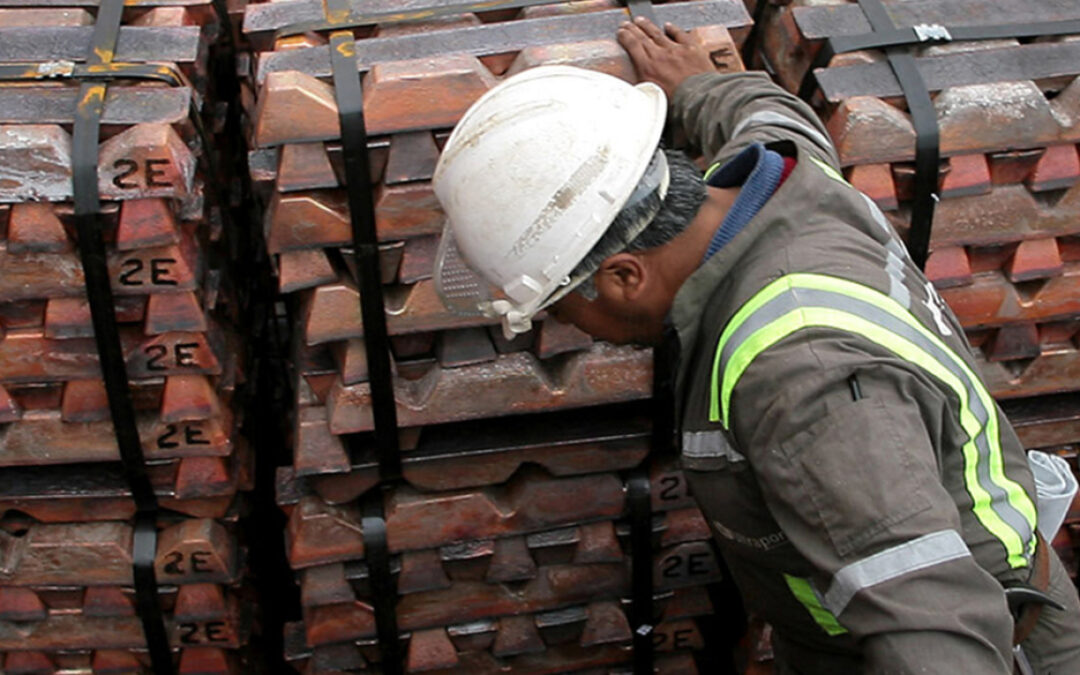
From January to May 2025, Mexican copper exports to the United States grew 12% to 419 million dollars, a result that dropped it to sixth place among the largest exporters to that market.
The 50% tariffs announced by President Donald Trump on imports of copper products have a potential impact of close to US$1 billion annually for Mexico.
Trump threatened to announce just this Tuesday a 50% tariff on imported copper as part of an effort to boost local production of the metal.
In 2024, Mexico was the third largest foreign supplier of copper and related products to the U.S. market, with shipments of 976 million dollars, surpassed by Chile (6,117 million) and Canada (3,994 million), according to data from the U.S. Department of Commerce.
Copper is mainly used in the manufacture of electrical cables, electronic components, piping, heating and cooling systems, as well as in construction and the automotive industry. Its high electrical and thermal conductivity makes it essential in a variety of industrial applications.
From around the world, copper imports to the United States totaled 17.11 billion dollars, making the U.S. the second largest importer, behind China, with 72.79 billion dollars. The U.S. market does not import copper ores and concentrates.
At the end of the presentation of the Made in Mexico seal to MOBILITY ADO, when asked by the press about Trump’s statement, Mexico’s Secretary of Economy, Marcelo Ebrard, replied: “First, we are going to find out more in detail. I will have a call today with U.S. authorities and I will be able to give a more precise position, because even they did not know. We need to know what it applies to. Let’s understand that first.
Section 232 of the Trade Expansion Act of 1962 authorizes the President to impose import restrictions, such as tariffs, if the Secretary of Commerce determines that a product is being imported into the United States in such quantities or under such circumstances as to threaten to impair national security.
Referencing the Commerce Department’s 2018 and 2019 determinations, Trump invoked Section 232 to impose tariffs on U.S. imports of steel, aluminum, automobiles and auto parts in 2025.
In addition, Trump could consider similar measures, depending on the findings of ongoing investigations into imports of lumber, semiconductors, pharmaceuticals, critical minerals, trucks and aircraft.
From January to May 2025, U.S. imports of copper and related products soared 73%, to 10.44 billion dollars, probably following similar effects to previous cases in which companies anticipate shipments to the U.S. market to avoid the additional costs implied by tariffs.
In those five months, Mexican copper exports to the United States grew 12%, to 419 million dollars, a result that dropped it to sixth place among the largest exporters to that market.
During the same period, exports from Germany grew 58%, those from Chile increased 117% and those from Peru 66%. While those from Canada grew only 1%, those from the Democratic Republic of Congo catapulted from 26 million to 606 million dollars.
On the other hand, Trump affirmed this Tuesday that countries that make up the BRICS group will have a 10 percent tariff imposed on them “very soon”.
“Anybody that is part of BRICS will get a 10 percent tariff very soon,” Trump said during a meeting with Cabinet officials at the White House.
Trump told reporters he planned to make the copper tariff announcement later Tuesday, but did not say when the tariff would take effect.
The Trump administration announced in February a so-called Section 232 investigation into U.S. imports of the metal.
Trump also said he is probably two days away from sending the European Union a letter revealing the tariff rate he will impose on U.S. imports originating from that bloc.
Trump said during the meeting that the European Union had treated the United States very well recently in trade talks.
Finally, Trump said he is planning to announce tariffs on imported semiconductors and pharmaceuticals, anticipating that the rate for drugs could reach 200%, but that he would give drugmakers about a year to get their act together.
“We’re going to give people about a year, a year and a half to get in and, after that, they’re going to be hit with tariffs,” Trump told reporters, speaking at a meeting of his Cabinet at the White House.
“If they have to bring pharmaceuticals into the country (…) they’re going to have tariffs at a very, very high rate, like 200%. We will give them a certain period of time to get their act together,” he added.