



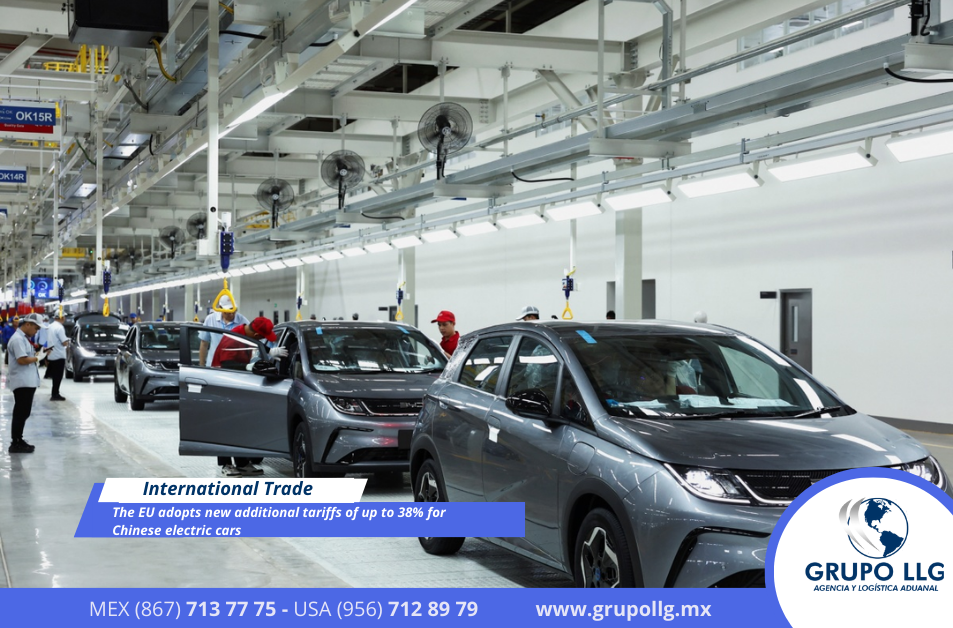
The European Union announced this Thursday the provisional adoption of additional compensatory duties of up to 38% to Chinese companies manufacturing electric vehicles, considering that these firms benefit from “unfair” subsidies.
The European Union announced this Thursday the provisional adoption of additional compensatory duties of up to 38% to Chinese companies manufacturing electric vehicles, considering that these firms benefit from “unfair” subsidies.
These subsidies represent a “threat of economic damage to European producers,” the European Commission, the EU’s executive arm, said in a statement.
The new tariffs will apply from July 5.
The EU intends to adopt a definitive measure in November, but until that period it will maintain dialogue with China in search of a solution, although the Chinese authorities have already warned that they will apply retaliatory measures.
The Chinese Chamber of Commerce in the EU (CCCEU) denounced Thursday’s decision as a “protectionist measure.”
The entity, which represents more than a thousand Chinese companies in the EU, said it felt “deeply disappointed and dissatisfied” by the decision announced this Thursday.
In its statement, the European Commission pointed out that the adoption of these provisional and additional tariffs is the result of an investigation that lasted nine months.
That investigation, the Commission noted, concluded that the electric car value chain in China “benefits from unfair subsidies, which is causing a threat of economic harm to EU producers.”
“The investigation has also examined the possible consequences and impacts of these measures on importers, users and consumers of electric cars in the EU,” he added.
Thus, the Commission announced the provisional adoption of tariffs of 17.4% for the giant BYD, and 19.9% for Geely, as well as customs duties of 37.6% for SAIC.
Other electric car producers in China that cooperated in the investigation are subject to average tariffs of 20.8%, while for companies that did not cooperate it rises to 37.6 percent.
In May, the European Commission had already threatened to increase tariffs up to 38%, which would be added to the current import duties of 10 percent.
Hope in dialogue
The move will come despite trade talks between China and the EU on June 22.
According to European Trade Commissioner Valdis Dombrovskis, the EU will continue to “collaborate intensively with China on a mutually acceptable solution.”
“Any negotiated outcome of our investigation must clearly and fully address the EU’s concerns and respect World Trade Organization rules,” the official said in a note.
Last month, China opened an investigation into pork imports, threatening Spanish exports.
Chinese officials have also criticized investigations targeting state subsidies in the green technology sector, including wind turbines and solar panels.
The EU seeks to generalize electric vehicles, as the bloc will ban the sale of new cars powered by fossil fuel engines from 2035.
At the same time, it is proposed to protect the bloc’s automobile industry.
However, Germany – an automobile powerhouse and an important trading partner of the Asian giant – fears that high tariffs will generate retaliation that will hit its activities in the Chinese market.
This Thursday, the German giant Volkswagen rejected the high tariffs announced by the EU, considering them “harmful.”
“The negative effects of this decision outweigh the possible benefits for the European automobile industry and in particular for Germany,” the group said.
Electric vehicles from China represent almost 22% of the European market, compared to 3% just three years ago, according to estimates from the automotive sector.