



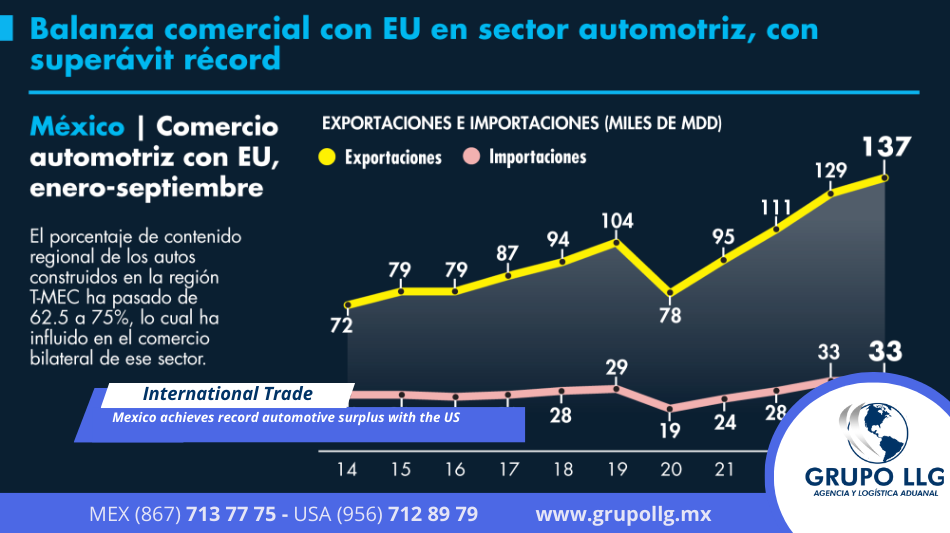
The balance in favor of our country during the period amounted to 103,977 million dollars, but GM, Ford and Stellantis consider that the gap hides behind a high American content in Mexican exports.
Mexico achieved a record surplus in its automotive trade balance with the United States from January to September 2024, at 103,977 million dollars, according to data from the Department of Commerce.
With the exception of 2020, when the greatest impact of the Covid-19 pandemic occurred, this surplus escalated year after year in the last decade. In the period corresponding to 2024, it was the first time that the positive balance exceeded 100,000 million dollars.
Because vehicle production in Mexico and Canada has such high levels of U.S. content, actual deficits were substantially lower, the American Automotive Policy Council (AAPC) said in a recent letter to the Department of Commerce.
The AAPC represents the public policy interests of the American automakers: Ford Motor Company, General Motors Company, and Stellantis. “Few policies have had as much impact on our industry and, in particular, on the American automakers, Ford, General Motors, and Stellantis, as the series of free trade agreements between the United States, Canada, and Mexico, which have been accumulated in the USMCA,” it added.
The AAPC indicated that prior to the USMCA (effective since July 2020) and the Inflation Reduction Act (IRA) of 2022, the trend in North American trade was a steady level of growth in imports from Mexico and a growing trade deficit with the United States’ trading partners with its North American partners. However, he considered that since the implementation of the USMCA, which raised the regional content value from 62.5% to 75% for essential parts, the US automotive trade deficit with its USMCA trading partners has remained relatively stable and he believed that this represents an “important new and positive trend.”
“However, since vehicle production in Mexico and Canada has such high levels of US content (35% and 50% US content respectively), the actual deficits were substantially lower anyway,” he said. Considering the first three quarters of each year, Mexico’s automotive exports to the US market rose from $72.048 billion in 2014 to $137.068 billion in 2024.
Conversely, US exports to the Mexican market rose from $25.784 billion in 2014 to $33.091 billion.
The 2022 IRA allocates about $380 billion for tax incentives and other support related to clean energy and climate change. This includes tax credits for renewable energy production, incentives for the purchase of electric vehicles, and other subsidies that encourage the transition to a more sustainable economy.
Over the past two years, companies announced $133 billion in new investments in clean energy and vehicle technology manufacturing in the United States, a 52% increase over the previous two years.