



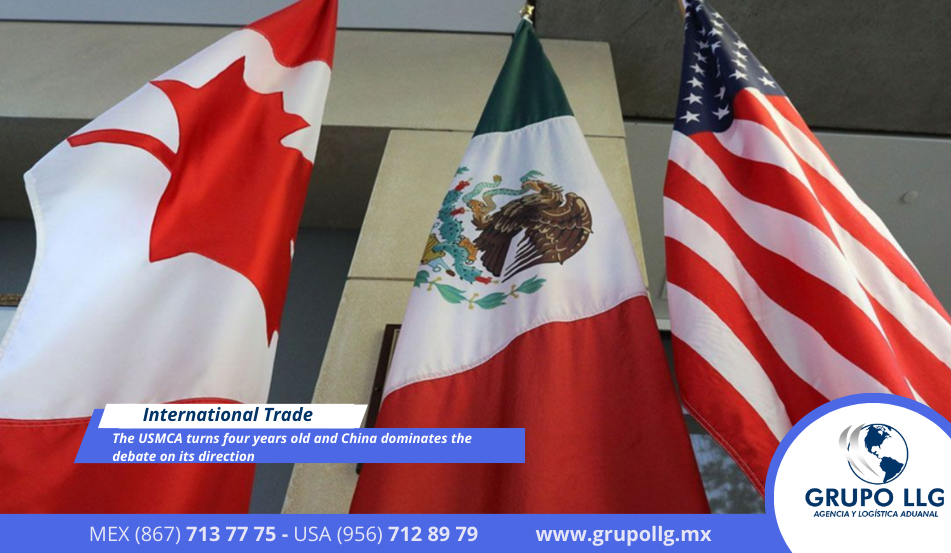
The treaty will be maintained because it has been confirmed as a strength of the United States to compete with the Asian power, but it could become more restrictive in terms of rules of origin to strengthen regional integration, experts say.
The China factor has emerged as the central issue on the direction of the Treaty between Mexico, the United States and Canada (T-MEC), when this Monday it turns four years since its entry into force and in view of its review scheduled for 2026, according to international trade analysts.
When the North American Free Trade Agreement (NAFTA, predecessor of the T-MEC) was renegotiated, it was already known that the United States required Mexico to compete against China, but now this is felt more extensively in the societies of the three countries in the region and among politicians.
“The United States is a very polarized society, there is no consensus, except on China, and Mexico is a key piece in the United States’ competition with China,” said Luis de la Calle, general director of the consulting firm De la Calle, Madrazo, Mancera (CMM).
Article 34.7 of the USMCA establishes that the agreement will end 16 years after its entry into force, “unless each party confirms that it wishes to continue this Agreement for a new period of 16 years,” in accordance with the procedures of the USMCA.
These procedures establish that, in July 2026, on its sixth anniversary, the USMCA Free Trade Commission will meet to review the agreement and the recommendations presented by the three member countries, and decide on the appropriate actions.
It seems very difficult for the United States to withdraw from an agreement where it is its number one client, its number two client and its main instrument to compete against its main competitor: China,” added De la Calle. “Yes, it can, but it is difficult.”
Alejandro Rodríguez, an analyst at the American consultancy Plante Moran, agrees with this. He highlighted the growing integration of North America, with Mexico positioned as the United States’ first commercial partner from 2023 until now.
“Quite apart from this, it will be important to monitor what is going to happen, since the issue of China is going to be central to the review of the T-MEC,” he said.
Rules of origin, debate
Rodríguez said that it is not yet known whether the United States will want to limit Chinese content in Mexico’s exports to the US market, tightening the rules of origin of the treaty in a general way, applicable to any nation outside of North America.
The new provisions on more restrictive rules of origin in the motor vehicle sector may be of interest to the United States again, just as it happened in the renegotiation of NAFTA.
The rules of origin of the automotive sector of the T-MEC are probably the strictest of any US free trade agreement and the only ones that have a salary requirement.
But a U.S. congressional analysis warns that the cost of compliance may have unintended consequences if manufacturers find it more beneficial to pay tariffs rather than pay the additional cost of complying with the new rules.
If manufacturers decide to pay tariffs rather than adhere to regional value content requirements, it could lead to less North American content and more content from third countries, including China, in U.S. auto production.
Policymakers will be able to monitor the full effects of these new rules as they are fully implemented. According to a July 2023 report from the U.S. International Trade Commission, the full effect of the rules of origin will likely not be apparent until the agreement is fully implemented in 2027 or later.
Sovereignty and Chinese Investments
As for potential Chinese investments in Mexico, Rodriguez said it is more complicated to limit them, because issues of national sovereignty are already involved. On the contrary, a general tariff can be imposed, as proposed by Donald Trump, former president and now presidential candidate of the United States, although this action has controversial regulatory and economic impact aspects.
Rodríguez explained that the review will be critical and will demonstrate why the United States put it on the table, because the scenario of North America and the world is now very different from when the T-MEC was approved.
“I think it is being proven that, in reality, it was important to raise the issue of a review every certain period, to be able to ensure that the agreement remains in force,” he said.
Rodríguez believed that Mexico will have control in its hands and that the future of this country is more in internal aspects, such as increasing infrastructure and generating an environment to attract investment, than what could happen with the T-MEC.
In auto production, the USMCA raises the Regional Content Value (RCV) from 62.5% of NAFTA to 75%, and also puts wage requirements stipulating that between 40 and 45% of the content be made by workers earning at least $16 per hour.
What’s next for the USMCA?
In the Final Provisions chapter of the USMCA, the parties commit to review the agreement on the sixth anniversary of its entry into force.
If in said review it is decided not to renew an extension, the USMCA would remain in force for another 10 years.
But if they decide to renew it, the validity will be extended for another six additional years, for a total of 16 years.
If one of the parties does not confirm its desire to extend the validity of the agreement for another 16-year period, the parties will carry out a joint review of the agreement every year.
The agreement only specifies that one “party” will review the agreement; It does not say whether it will be the President or the US Congress who will review it.
roberto.morales@eleconomista.mx
El T-MEC cumple cuatro años y China domina el debate sobre su rumbo (eleconomista.com.mx)