



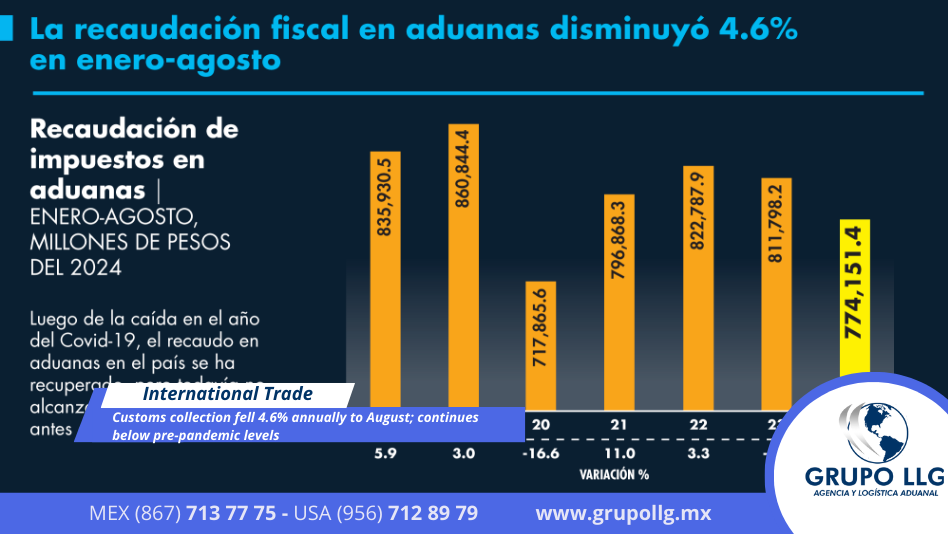
Tax collection at the country’s 50 customs offices, one of the important points for public revenue, reported a decrease between January and August in its annual comparison and thus continues below the levels reported prior to the Covid-19 pandemic.
Data from the National Customs Agency of Mexico (ANAM) showed that between January and August of this year, the treasury obtained 774,151 million pesos for taxes that were collected in foreign trade operations, which represented a decrease of 4.6% compared to the year before.
In this way, tax collection at customs added two consecutive years of annual decreases during the period from January to August.
Although customs collection has recovered after the economic crisis caused by Covid-19, the level collected still cannot match or exceed what was seen before the pandemic.
In the same period in 2019, when Mexico was not yet going through an economic crisis, the 49 customs offices that operated in the country at that time obtained 860,844 million pesos, with real figures.
Juvenal Lobato, an academic at UNAM, indicated that the decrease in tax collection at customs may be due to three factors: the first of them, the transition of government this year, in addition to a learning curve for the military who began to control them.
Another factor, he added, was the questioning of the constitutionality of the creation of ANAM, which could lead to workers being more cautious in their auditing and review functions.
Previously, a collegiate court declared the Internal Regulations of the National Customs Agency of Mexico (RIANAM) unconstitutional, holding that its creation, by presidential decree, violated the principle of hierarchical subordination.
For this reason, ANAM and the Federal Tax Attorney’s Office promoted means of defense against this resolution, and in September the Supreme Court of Justice of the Nation (SCJN) declared the ANAM regulations constitutional and, therefore, its creation.
“In addition to this, it held that in aid of the Tax Administration Service, ANAM is exclusively in charge of the direction, organization and operation of customs and inspection services, to apply and ensure compliance with the legal norms that regulate the entry and exit of goods from the national territory, as well as the collection of customs revenues,” said ANAM.
The creation of ANAM, during the six-year term of Andrés Manuel López Obrador, had the purpose of trying to strengthen the Mexican customs system, and thus became a decentralized body of the Ministry of Finance and Public Credit, with technical, operational, administrative and management autonomy. Previously, the SAT exercised its function through the General Administration of Customs (AGA).
Its creation was accompanied by criticism about a possible militarization, given that the Armed Forces will be able to occupy important positions within this new agency.
Nuevo Laredo, the king
ANAM data showed that the Nuevo Laredo customs office, on the northern border, continues to be one of the most important in the country, in terms of revenue. Between January and August of this year, it left resources for the treasury for 130,556 million pesos.
It was followed by the Manzanillo customs office, which left resources for 107,989 million pesos, while the Veracruz maritime customs office obtained third place by leaving income for 89,890 million pesos.
In total, the revenue left by the 50 customs offices in the country represented 23 of every 100 pesos obtained from taxes, and exceeded the 422,235 million pesos of resources obtained from the payment of IEPS by taxpayers.
Sheinbaum’s plan
Among the proposals that President Claudia Sheinbaum brings to promote in her government is the simplification of procedures, which would also apply to customs operating in the country via digitalization, with which she will seek to increase tax collection in them.
According to the speeches and campaign promises that Sheinbaum gave, a technicalization in customs could lead to having extra resources for 250,000 million pesos.
“By technicalizing, we will not only advance in the export and import of goods, but we also have a very broad opportunity for collection, we think that, at least, it is another 250,000 million pesos, which represents almost 1% of the Gross Domestic Product,” she said in Guadalajara during the campaign.
The above, added Juvenal Lobato, is positive, especially in the face of the corruption that, for years, has permeated the country’s customs and, therefore, tax collection has been affected.